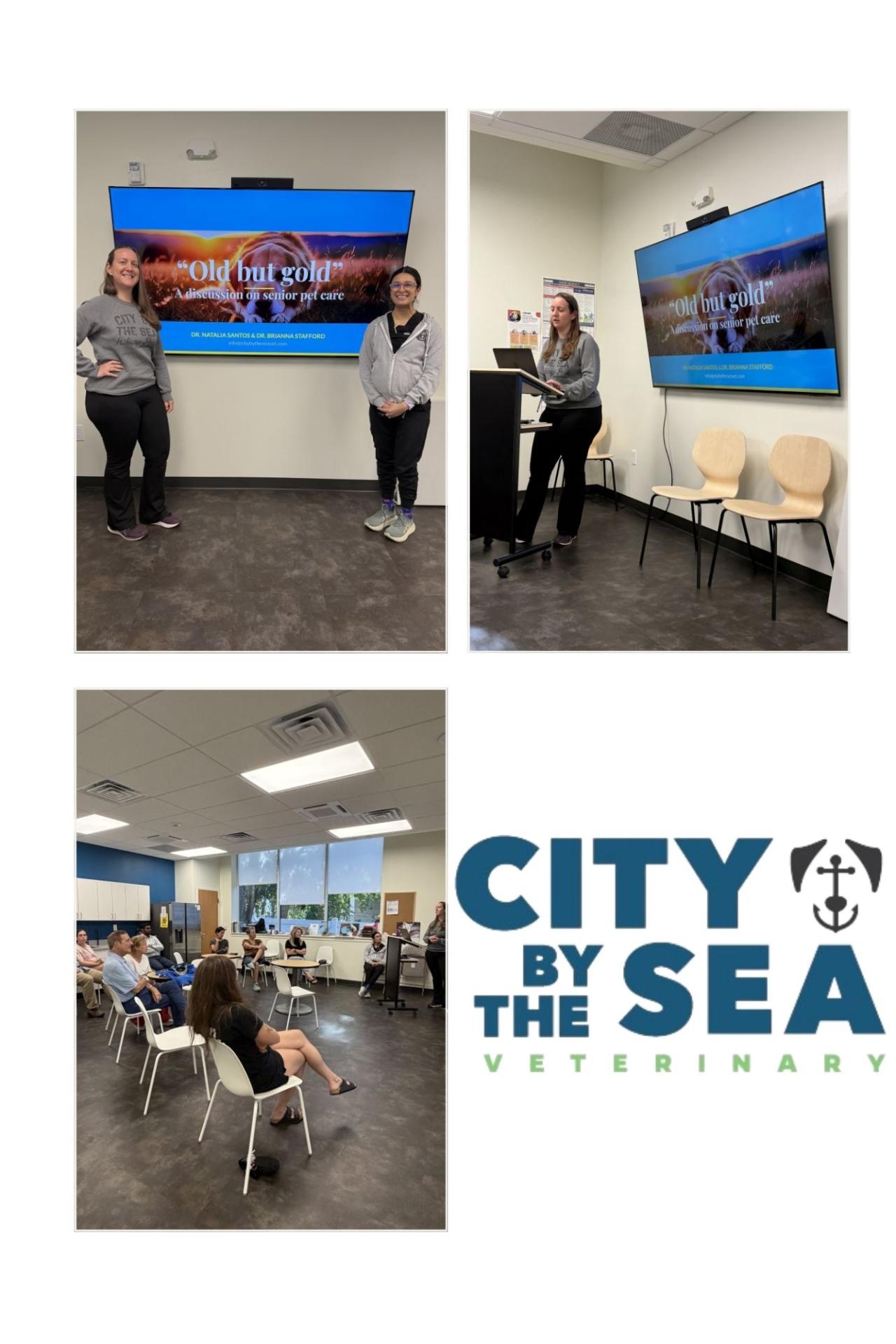



Your dog or cat's later years can be some of their best. Here's how to spot what's changing, ease the aches of age, and keep them comfortable for longer.
From a recent talk by Dr. Natalia Santos-Melody & Dr. Brianna Stafford
The goal of senior care is simple: more good days, with less pain.
Aging isn't a disease, but it does change what your pet needs from you. The earlier you notice the small shifts — a hesitation before the couch, a little less spring in a walk — the more we can do to keep your companion moving comfortably and feeling like themselves. This guide covers the questions we hear most from families of older pets here in Asbury Park. For an overview of our dedicated services, see our senior dog care page.
First things first
When is a pet a "senior"?
It's often earlier than people expect — and it depends on the species and size.
10+ Years · Cats
Cats are generally seniors once they pass their tenth birthday.
Last ¼ of life · Dogs
Dogs reach their senior stage in the last quarter of their expected lifespan — sooner for large breeds.
The everyday essentials of senior pet care
Most of what keeps a senior pet thriving happens between visits — in the food bowl, on the daily walk, and in a few small changes around the house.
Nutrition
Feed for the years they're in. Older pets often need more protein, not less, to hold onto muscle. And if your pet is managing kidney disease, joint issues, or another condition, a prescription diet can do real work alongside medication. Ask us about senior nutrition.
Movement
Keep them gently active
Motion lubricates joints, preserves muscle, and sharpens the aging mind — the trick is the right kind.
- Short, frequent walks beat one long hike
- Sniffing and varied terrain keep the brain working
- Ease off zoomies, sprints, and sharp turns that jolt aging joints
Around the house
Make the home easy to navigate
A few changes go a long way for a stiff or unsteady pet.
- Runners and rugs over slippery floors
- Toe grips for extra traction
- A support harness for stairs and getting up
Mind & mood
Keep them engaged
Mental stimulation helps lower the risk of canine cognitive decline — the pet version of "use it or lose it." New sniffs, gentle play, and food puzzles all count.
The single biggest lever
A lean pet is a longer-lived pet
Roughly one in two pets is overweight, and it quietly drives a long list of diseases. Studies show lean dogs can live around 1.5 years longer than overweight ones. We aim for a body condition where the ribs are easy to feel and there's a visible waist — a 4 to 5 on the chart.
It's also the one tool that's entirely in your hands at home, and often the most powerful thing you can do for an arthritic pet.
Body Condition Score chart for dogs scored 1 to 9, with 4 to 5 marked as the ideal range
Body Condition Score chart — aim for the "ideal" range. Source: Association for Pet Obesity Prevention.
The one thing to remember
Pets are stoic. Quiet doesn't mean pain-free.
This was the heart of the talk. Animals instinctively hide discomfort, and many won't cry or whimper even when they hurt. A pet that has "just slowed down with age" is very often a pet in pain we can help. Limping is always a sign of pain — and in cats especially, the signs are subtle.
- Not jumping to counters or favorite perches
- Hesitating at stairs or the car
- Grooming less; a scruffier coat
- Accidents outside the litter box
- Favoring a leg, or shorter jumps
- Sleeping more, playing less
A closer look
About arthritis in dogs and cats
Osteoarthritis is behind a lot of "old age" stiffness — and the biggest surprise for owners is how early it starts.
Not just an old-pet problem, It can start young
About 40% of dogs aged 8 months to 2 years already show signs of arthritis. And roughly 90% of cats have arthritis changes on X-ray by age 12 — though only a fraction show obvious symptoms.
Why it happens
Often a knock-on effect
Arthritis is frequently secondary to something else — extra weight, body build, old injuries, even tick-borne disease. Cartilage damage is permanent, which is exactly why getting ahead of it matters.
The good news
There's far more than "just drugs"
The best results come from combining several gentle approaches, so we lean less on any single one. Every plan is built around the individual pet — their other conditions, their temperament, and what fits your life.
Staying comfortably active is part of the treatment, not a break from it.
The toolkit
How we manage senior pet pain
A multimodal plan might draw on any mix of these:
- Modern medications
- Newer monthly injections — Librela for dogs, Solensia for cats — target pain directly, plus trusted options like NSAIDs when they're a good fit.
- Supplements
- Omega-3s, green-lipped mussel, and others can help — but only quality, third-party-tested products chosen for your pet.
- Acupuncture
- A gentle, non-invasive way to ease pain, improve blood flow, and relax tight muscles. Learn more about our acupuncture service.
- Physical medicine
- Massage, stretching, laser therapy, shockwave, and underwater treadmill all support comfort and mobility.
- Weight & movement
- Often the most powerful tool of all — and entirely in your hands at home.
⚠ A word of caution
Never give human pain relievers like Advil or Tylenol without us. They can be dangerous — even deadly — for pets.
Staying ahead of it
Why senior checkups matter more
As pets age, we often suggest visits twice a year instead of once. More frequent check-ins let us catch changes while they're small and easy to act on.
What we look at:
- Bloodwork to check organ function
- Urine testing and blood pressure
- Imaging or screening when something needs a closer look
If cost is a worry, Tell us — we'll plan around it
If you have pet insurance, it's worth checking your coverage before larger workups. And if finances are a concern at all, just say so. We'd rather help you prioritize than have you skip care.
At City by the Sea
What we offer
Senior care is something our whole team is comfortable with — and a few of our doctors bring extra training to it.
- Every one of our doctors
- Knows how to diagnose and manage arthritis and senior pain.
- Digital X-rays on site
- To confirm what's going on — usually with gentle sedation for clearer images and a calmer pet.
- Dr. Stafford
- Offers acupuncture consults for pets who'd benefit.
- Dr. Cherrone
- Handles shockwave therapy and orthopedic surgery consults.
Noticing a few of these in your pet?
Let's take a look together. A senior wellness visit is the best first step toward more comfortable years ahead.
Call us · (848) 217-5000 Email the team
City by the Sea Veterinary
Compassionate, quality care in Asbury Park, NJ
General Practice
1411 Memorial Drive, Asbury Park
Urgent Care
1309 Memorial Drive, Asbury Park
This page is for general education and isn't a substitute for an exam. Every pet is different — please reach out so we can tailor advice to yours. Based on the "Old but Gold" senior pet care talk by Dr. Natalia Santos-Melody and Dr. Brianna Stafford.